Bookdio Summary vs Traditional Reading: Which One Is Right for You?

Updated: May 20
Is a Bookdio summary actually as effective as reading a full book? Or are you missing something important?
Let’s break it down in a practical, no-nonsense way so you can decide what works best for you.

What Is a Bookdio Summary?
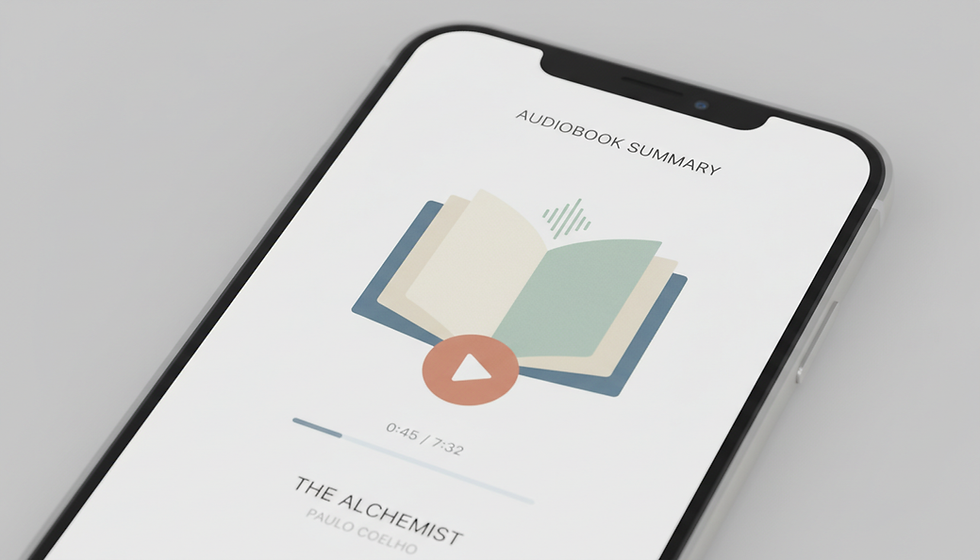
A Bookdio summary is a condensed version of a book that highlights the key ideas, insights, and takeaways. Instead of spending 6–10 hours reading a full book, you can understand the core message in a fraction of the time.
Think of it like this: You’re not reading every word. You’re extracting the value.
These summaries are especially useful for:
Busy professionals
Students juggling multiple subjects
Readers who want to explore more books in less time
Traditional Reading: The Full Experience
Traditional reading means going through a book from start to finish, absorbing not just the ideas but also the depth, examples, and storytelling.
It gives you:
Context behind every idea
Nuance and detailed explanations
A deeper emotional or intellectual connection
For example, reading a biography or a complex subject like psychology often benefits from full immersion.
Bookdio Summary vs Traditional Reading: Key Differences
1. Time Investment
Bookdio summary: Takes minutes to an hour
Traditional reading: Takes several hours or days
If your goal is to learn quickly, summaries clearly win here.
2. Depth of Understanding
Bookdio summary: Covers the main ideas
Traditional reading: Explores ideas in depth
Summaries give you the “what.” Books give you the “why” and “how.”
3. Retention and Recall
This depends on how you use the content.
A quick summary might be easy to forget if you skim it.
A full book sticks better because of repetition and storytelling.
However, if you actively engage with a Bookdio summary (take notes, revisit it), retention improves significantly.
4. Learning Efficiency
Here’s where things get interesting.
If you’re trying to:
Get familiar with a topic
Decide whether a book is worth reading
Learn key concepts quickly
Then a Bookdio summary is incredibly efficient.
But if you’re trying to:
Master a subject
Build deep expertise
Think critically about ideas
Traditional reading still has the edge.
When a Bookdio Summary Is the Better Choice
A Bookdio summary works best when:
You’re short on time
You want to scan multiple books quickly
You need quick insights for work or study
You’re exploring a new topic
Example: If you want to understand the core ideas of 10 business books in a week, summaries make that possible.
When Traditional Reading Is Worth It
Full reading is better when:
The subject is complex (e.g., philosophy, science)
You want deeper understanding
The writing style or storytelling matters
You’re studying something long-term
Example: Reading a novel or a detailed self-help book often requires full context to truly connect with it.
The Smart Approach: Use Both Together
You don’t have to choose one over the other.
In fact, the best learners combine both.
Here’s a simple strategy:
Start with a Bookdio summary
Get the main ideas quickly
Decide if the book is worth your time
If yes, go deeper with a full reading
Revisit the summary later
Use it as a quick refresher
This approach saves time while still giving you depth when it matters.
Conclusion: Which Is Better for Learning?
So, which is better for learning: a Bookdio summary or traditional reading?
It depends on your goal.
If you want speed and efficiency, go with Bookdio summaries.
If you want depth and mastery, stick with full books.
Most importantly, don’t think of summaries as shortcuts in a negative way. Think of them as tools.
Used well, a Bookdio summary can help you learn faster, explore more ideas, and make better decisions about what’s worth your time.
Explore More with Bookdio
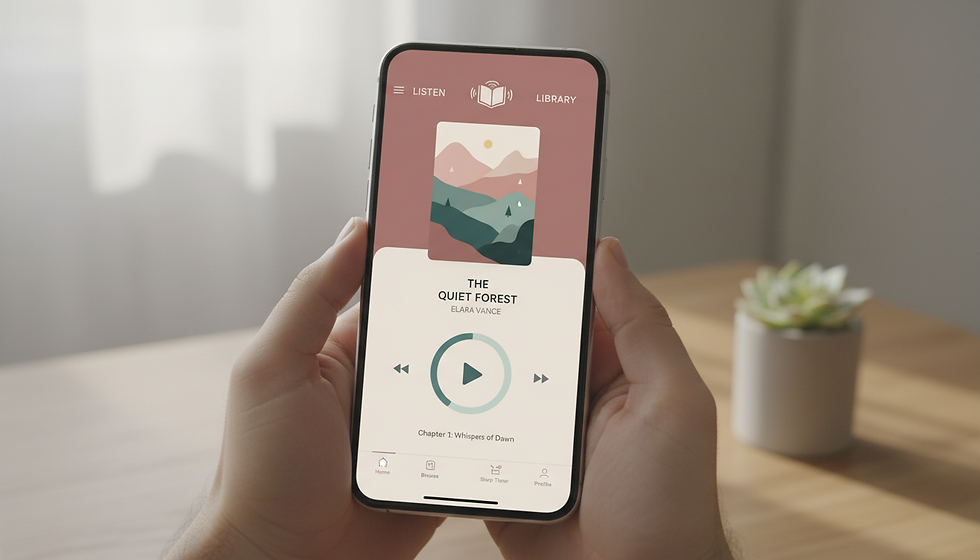
If you’re curious about diving deeper into the world of audiobooks, check out Bookdio for more summaries and insights. It’s a great way to expand your knowledge without feeling overwhelmed.
Remember, the right choice depends on your needs. Embrace both methods to maximize your learning journey!